



Mental health coverage under Medicaid can be confusing, especially when treatment involves more than one person. Many families ask does Medicaid cover couples therapy, or whether counseling must be individual to qualify for benefits.
The answer depends on how the therapy is structured, who the identified patient is, and whether the service meets Medicaid’s medical necessity rules. Understanding these details helps couples and families know what care may be covered and how to access it without unexpected denials.
1. Does Medicaid Cover Couples Therapy
Medicaid may cover couples therapy, but coverage is not automatic. In most states, Medicaid only pays for therapy when there is a clearly identified patient and a documented medical or mental health need. Couples therapy is usually covered only when it is part of treatment for one person’s diagnosed condition, such as depression, anxiety, trauma, or substance use disorder.


If therapy is focused mainly on relationship improvement without a medical diagnosis, Medicaid often denies the claim. Coverage depends on how the service is billed, the provider’s credentials, and state-specific Medicaid rules.
2. What Therapy Can You Get With Medicaid
Many people ask, what therapy can I get with Medicaid, and the answer is broader than expected. Medicaid covers a range of mental and behavioral health services when they are considered medically necessary.
Individual Therapy
Individual therapy is the most consistently covered service under Medicaid. This includes:
- Counseling for depression, anxiety, PTSD, and other mental health conditions
- Therapy provided by licensed professionals such as psychologists, clinical social workers, or counselors
- In-person or telehealth sessions, depending on state policy
Individual therapy is usually easier to approve because the patient and diagnosis are clearly defined.
Family and Couples Therapy
Family and couples therapy may be covered when:
- One person is the primary patient with a diagnosed condition
- The therapy is part of that person’s treatment plan
- The provider documents how family or partner involvement supports clinical progress
In these cases, Medicaid views couples therapy as a treatment method rather than a relationship service.
Group Therapy and Behavioral Health Services
Medicaid often covers:
- Group therapy for mental health or substance use treatment
- Behavioral health programs connected to clinics or community providers
- Structured therapy groups with treatment goals and progress notes
Group therapy is commonly used when it supports ongoing recovery or symptom management.
3. How Many Therapy Sessions Does Medicaid Pay For
There is no single national limit on sessions, which is why people often ask, how many therapy sessions does Medicaid pay for. The answer depends on several factors:
- State Medicaid policies
- The type of therapy provided
- Medical necessity and progress documentation
Some states set annual visit limits, while others approve sessions based on treatment need and periodic reviews. Continued coverage often requires the provider to show that therapy remains necessary and effective.
4. Why Couples Therapy Is Sometimes Denied by Medicaid
Couples therapy is often denied by Medicaid because the program is designed to pay for medical treatment, not general relationship counseling. Denials usually happen when the service does not meet Medicaid’s definition of medical necessity.
Common reasons couples therapy claims are rejected include:
- No primary diagnosis: Medicaid typically requires one person to be identified as the patient with a documented mental health condition.
- Therapy goal is relationship improvement only: Sessions focused on communication or relationship satisfaction, without a clinical treatment goal, are rarely covered.
- Incorrect billing codes: If the provider bills the session as marital counseling instead of treatment tied to a diagnosed condition, Medicaid may deny payment.
- Provider limitations: Some therapists are not enrolled as Medicaid providers or are not authorized to bill for family-based therapy.
- State-specific restrictions: Medicaid rules vary by state, and some programs limit or exclude couples therapy regardless of diagnosis.
In many cases, coverage depends less on the type of therapy and more on how the service is documented and billed.
>>> Read more: Does Medicaid Cover Root Canals in 2026? State Policies, Costs, and Patient Options
5. How to Find Medicaid Providers That Offer Couples Therapy
Finding a Medicaid provider who offers couples therapy takes a bit of extra screening, since not all therapists accept Medicaid or provide family-based treatment.
Start with these steps:
- Use your state Medicaid provider directory to search for mental or behavioral health providers who accept your plan.
- Call providers directly and ask whether they offer family or couples sessions as part of treatment for an individual diagnosis.
- Confirm billing details by asking how they bill couples therapy and whether Medicaid typically approves it in your situation.
- Check community mental health clinics, which are more likely to offer Medicaid-covered family and behavioral health services.
- Ask about telehealth options, since some Medicaid plans allow virtual therapy sessions that may expand your provider choices.
Before scheduling, confirm that the provider accepts your specific Medicaid plan and that couples therapy is included as part of a documented treatment plan. This step can help avoid denials and unexpected out-of-pocket costs.
6. How Medicaid Members Can Get a Free Phone Through Lifeline
Access to mental health care often depends on something very basic: staying reachable. Appointment reminders, follow-up calls, teletherapy links, and pharmacy notifications all rely on a working phone. Fortunately, Medicaid enrollment often opens the door to Lifeline, a federal program created to support essential communication for low-income households.
Instead of treating phone access as a perk, Lifeline treats it as infrastructure. For Medicaid members, that distinction matters.
Medicaid Automatically Qualifies You for Lifeline
Medicaid participation is one of the fastest ways to qualify for Lifeline. There is no separate income calculation required. Your active Medicaid status already meets the eligibility rules.
This automatic link exists because Medicaid agencies rely on phone access to:
- Send eligibility and renewal notices
- Coordinate behavioral health and therapy appointments
- Support telehealth and remote care
- Prevent coverage gaps caused by missed communication
For many people searching for a free phone on Medicaid, Lifeline is the program that makes ongoing care possible, not just accessible.
How to Get a Free Phone on Medicaid With AirTalk Wireless
Once Lifeline eligibility is confirmed through Medicaid, the next step is choosing a provider. AirTalk Wireless is a Lifeline-authorized provider that focuses on making enrollment simple and practical for Medicaid users.

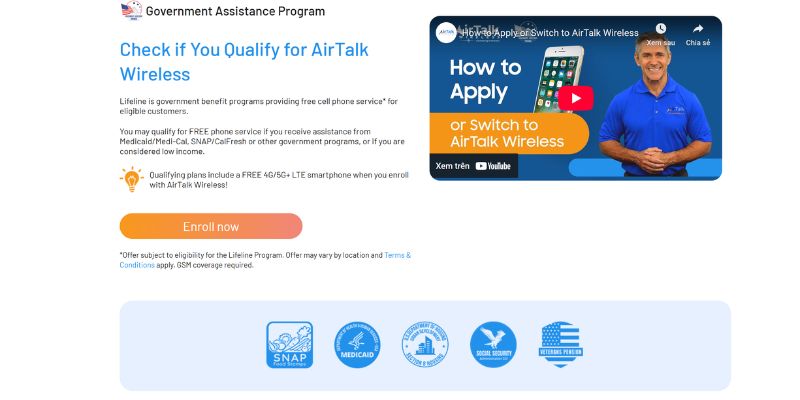
What AirTalk Wireless offers eligible Medicaid members:
- A free smartphone in qualifying states
- Monthly talk, text, and data at no cost
- No contracts, no monthly bills, no credit checks
- Nationwide coverage that supports telehealth and care coordination
The application process is straightforward:
- Apply using your Medicaid eligibility as proof
- Verify basic personal information
- Select your available device and plan
- Receive your phone and start using the service
For Medicaid members managing therapy schedules, renewals, or ongoing treatment, a reliable phone is not optional. It is part of staying enrolled and receiving care without disruption.

IMPORTANT: The government does not subsidize devices. Lifeline programs cover basic service costs only. Free or discounted devices, upgrade plans, or top-ups are exclusive benefits provided by AirTalk Wireless as part of our promotional offers. Terms and conditions apply. Limited-time promotion—offers vary by state, stock availability, and eligibility.
Conclusion
Medicaid coverage can include mental health services like individual or family-based therapy, but access does not stop at approval. Staying connected plays a real role in whether care actually happens. Programs like Lifeline, combined with providers such as AirTalk Wireless, help Medicaid members remove one of the most common barriers to care: communication. For those eligible, a free phone on Medicaid can be the link between coverage on paper and support in real life.